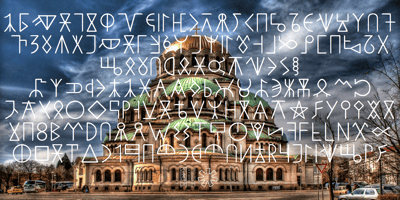

Ongunkan Proto Bulgarian Runic Font Family was designed by Osman Nuri ALKAN and published by Runic World Tamgacı. Ongunkan Proto Bulgarian Runic contains 1 styles and family package options. Kъnig – the old Bulgar runesThe writing kъnig emerged in the places of ancient Thraco-Bulgarian migrations in ante-deluvial times and developed in stages paralleling the other ancient writings. There have been many interactions and loanings between kъnig and these other writings.The root of the word kъnig (OBg: кънигъı) comes from the Old Chinese k’üen ‘scroll’ (ModCh: 纸卷 zhǐjuǎn) [57]. The word was loaned directly in the Bulgar language (*kün’ig > *küniv) restoring two individual Old Chuvash forms: 1. *k’ün’čьk > кўнчěк kind of ornament on a woman’s garment; *k’ün’-gi / *k’ün’-üg > k’ün’iv book, codex, which is evidenced by the Hungarian könyv book and Mordvinian konov paper borrowings; 2. *k’ün’i- > *k’ün’i-gi > к’әn’iγь > кънигъı . This word has been preserved in Sumerian as kunuku (inscription) and kəniga (writing, knowledge). It is inherited from Bulgar to Slavic: книга (Bulgarian and Russian), књига (Serbian, Croatian and Slovenian), kniha (Czech and Slovak), książka (Polish), and non-Slavic: könyv (Hungarian) languages.Kъnig letters (kъni) have been known from archeological finds for more than 100 years already; however, until recently, no attempt has been made to decipher them, find their phonological value, or connect them to their natural successors: the Glagolitic and Cyrillic alphabets.The oldest mention on the Bulgar runes is found in the mid-9th c. AD work On the Letters by the Bulgarian writer Chernorizets Hrabъr. Being already a Christian, he wrote pejoratively about the pagan Bulgars